IMS JOURNAL: AEO & AI Search
SEO vs AEO vs GEO: What's the Difference and Do You Need All Three?
SEO, AEO and GEO explained in plain English: what each term means, how they differ, why a Google ranking isn't enough for AI answers, and where to start.

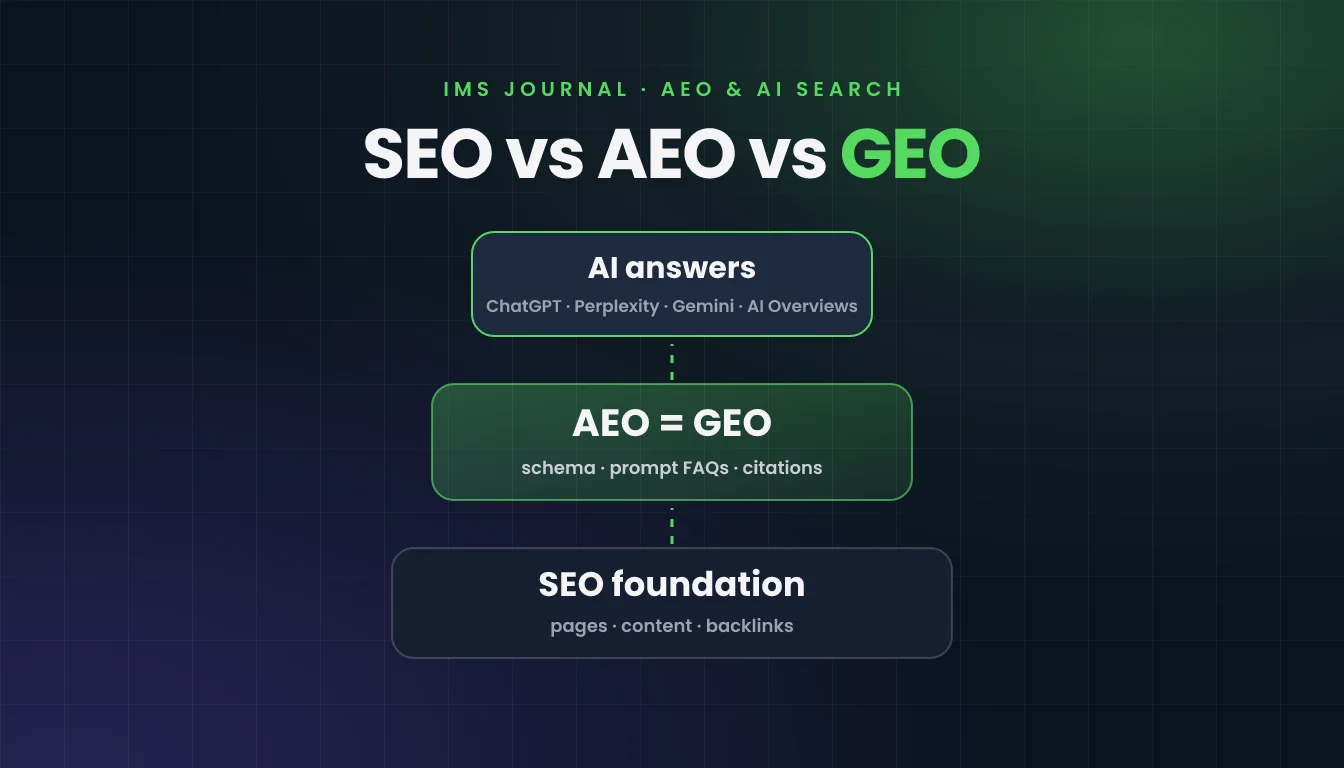
A company can sit on page one of Google and still go unmentioned when a buyer asks ChatGPT who to hire. That gap is the clearest way to see the difference between SEO, AEO and GEO. SEO aims at the list of results on a search engine. AEO and GEO aim at the answer an AI tool writes, the one that names a few companies and stops there.
Answer engine optimization (AEO) is the work of making your business easy for AI tools to find, understand and trust, so they mention and cite you in their answers. It isn't a replacement for SEO, and it isn't the same as using AI to write content. The distinction worth holding onto: SEO earns you a spot in a list of links, while AEO earns you a spot inside the answer itself.
This guide covers what each term means, how they overlap, why a strong Google ranking doesn't carry over to AI answers, and what to do first.
SEO vs AEO vs GEO: The Short Answer
Quick Answer: SEO is optimizing for a search engine, and AEO and GEO are optimizing for AI answers. AEO and GEO describe the same job, and both sit on top of SEO.
Solomon Thimothy, founder of IMS, explains it to prospects this way:
When I explain it, I say SEO is optimizing for a search engine. AEO is SEO at its core, plus what AI looks for: clarity in the content and verifiable information, because it goes and checks other places to confirm what it found is accurate.
| SEO | AEO | GEO | |
|---|---|---|---|
| Goal | Rank pages in search results | Get named and cited in AI answers | Same goal as AEO |
| Where you show up | Google and Bing results pages | ChatGPT, Perplexity, Claude, Copilot, Gemini, Google AI Overviews and AI Mode | The same AI platforms |
| What it rewards | Relevant pages, technical health and backlinks | Clear content, verifiable facts, structured data and third-party citations | Same as AEO |
| How you measure it | Rankings, clicks and organic traffic | How often AI mentions and cites you, and how you compare with competitors | Same as AEO |
Read across the table and the GEO column repeats the AEO column. That's the point. The two terms describe one discipline, and SEO is the foundation under both.
What Is SEO?
SEO (search engine optimization) is the work of helping your website rank in search engine results so people click through to it. It covers what's on your pages, like titles, meta descriptions, content, speed and site structure, and the signals from outside your site, mainly links from other websites.
SEO still matters in an AI world. Many AI tools search the web before they answer, and pages that are well built and already rank give them something to work with. That's why the SEO and content marketing foundation still comes first in an AEO program.
What Does AEO Stand For?
Quick Answer: AEO stands for answer engine optimization. An answer engine is any tool that replies with an answer instead of a list of links.
That includes ChatGPT, Perplexity, Claude, Microsoft Copilot, Google Gemini, and Google's AI Overviews and AI Mode. So what is AEO in practice? The AEO meaning, in plain terms, is making it easy for those tools to find your business, understand what you do and trust you enough to recommend you.
Solomon describes it as familiar work with an extra layer: "To us it's literally what we used to do, plus." With people who aren't technical, he drops the acronym altogether:
With less technical people I just say "AI search," because they know AI and they know search, and they put the two together.
What AI Engines Look For
AI engines look for content they can understand and facts they can confirm somewhere else. Each platform uses its own system to find and choose sources, and none publishes exactly how it weighs them. These are the signals IMS focuses on in client work:
| Signal | What it means | Example |
|---|---|---|
| Clarity | Content that says plainly what you do and who it's for | A service page that answers one buyer question per section |
| Verifiable information | Facts AI can confirm on other sites | The same name, services and details on your site, LinkedIn and Clutch |
| Structured data | Schema markup that labels the facts on a page | Organization, Service and FAQ schema |
| FAQs built from real prompts | Questions written the way buyers ask AI tools | "Which accounting firms work with owner-managed businesses?" |
| Third-party citations | Mentions of your business on sites AI already trusts | YouTube, LinkedIn, Medium, Clutch and press releases |
The last row carries more weight than people expect. As Solomon puts it, "Citations in AEO are what backlinks are in SEO."
A citation doesn't have to be a link. It can be an unlinked mention of your brand, an editorial reference in an article, a listing on a directory like Clutch or an independent review. What matters is that sources outside your website describe your business consistently, so AI has something to check your own claims against.
Find Out Whether AI Recommends You
Ask ChatGPT or Perplexity who the best company in your category is. If your name doesn't come up, IMS can help you see why and what to fix first.
Get Found in AI AnswersWhat Is GEO (Generative Engine Optimization)?
Quick Answer: GEO stands for generative engine optimization: improving how often your content shows up in answers written by AI systems.
The term comes from a 2023 research paper by Pranjal Aggarwal and colleagues, later accepted at the KDD 2024 conference. The paper describes generative engines as systems that use large language models to gather information from many sources and summarize it into a single answer. That's the same set of tools AEO targets, which is why the two terms overlap so completely.
Are AEO and GEO the Same Thing?
Quick Answer: For practical purposes, yes. IMS treats AEO and GEO as the same work under two names.
When people compare AEO vs GEO, Solomon is direct about why he doesn't split them:
I treat AEO and GEO as the same thing. There are so many words for it... I don't want a prospect to think there are three separate products. It's one job: showing up when people ask AI for an answer.
Not everyone uses the terms this way. Some people treat GEO as the research term for generative engines and AEO as the broader industry term. IMS takes the practical view: the work is the same, so we run it as one discipline.
One clarification helps here. Google AI Overviews is a place where AI answers appear, not a separate discipline. The same work that gets you cited in ChatGPT also supports your chances in Google's AI features, although each platform weighs sources differently. More on that below.
AEO vs SEO: What Changes and What Stays the Same
Quick Answer: The work you do for SEO still counts toward AEO. AEO puts more weight on structured data, FAQs built from real prompts and third-party citations, and it measures success inside AI answers instead of search rankings.
Solomon draws the line this way: the title tags, meta descriptions and page updates are the SEO side, while schema markup and structured data across the website are the AEO side.
| Area | SEO emphasis | AEO emphasis |
|---|---|---|
| Main objective | Rankings, clicks and organic traffic | Mentions, citations and recommendations in AI answers |
| Title tags and meta descriptions | Core | Still needed |
| Content | Built around keywords | Built around the prompts buyers type into AI tools |
| Structured data | Part of technical SEO | A higher priority, used across the site to label key facts |
| FAQs | Useful for long-tail searches | Written from real prompts and placed on the right pages |
| Off-site signals | Backlinks | Third-party citations and mentions, linked or not |
| Measurement | Rankings and traffic | Mentions, citations and share of voice on each AI platform |
| Business outcome | Organic traffic and conversions | AI visibility, recommendations and the leads they bring in |
In short, AEO keeps the SEO work and raises the bar on structure and proof.
Is GEO Replacing SEO?
No. GEO builds on SEO instead of replacing it. Many AI tools run their own web searches behind the scenes before they answer, a process often called query fan-out. Strong, well-ranked pages give them material to draw from. What's changed in the GEO vs SEO picture is that ranking alone no longer finishes the job.
Why Ranking on Google Doesn't Get You Into ChatGPT
Quick Answer: Ranking on Google and being recommended by AI are different tests. ChatGPT doesn't copy Google's results. It looks for what it can verify about your business.
Solomon says he sees this all the time, including with companies that have every advantage on paper:
It happens because ranking on Google and being recommended by AI are not the same game. ChatGPT doesn't go to Google and copy and paste the results. It has its own index, and it doesn't care about your history, your size, your ad budget or how amazing you are. It looks at what it can verify.
He points to a 50-year-old manufacturer with a big brand and real ad spend that didn't show up for its own keywords, while a company reselling its products did. He also points to an HVAC company with 32 years in business, great reviews and a fleet of trucks that didn't appear when he asked ChatGPT for the best HVAC company in its zip code.
The competitor that does get named may have better data about its business, better structured content, more citations or more proof. Solomon's take: "Maybe they're worse than you at the actual service, but AI is not mad at you. It just doesn't find you credible enough."
Example: Good Pages, Still Invisible to AI
A healthcare management software company Solomon worked with shows how close a site can be and still miss. It had a lot going for it, but the pieces AI relies on were missing:
They had individual pages for each service and an FAQ section, which is good. But they didn't have many FAQs, they didn't have the prompts people actually type as FAQs, and there was no schema markup around any of it. They also weren't in the top sources AI pulls from.
The fix followed directly from the diagnosis. In Solomon's words, "The fix was to add the prompts as FAQs with schema, put each one on the right page, and build citations on places like YouTube, LinkedIn, Medium, Clutch and press releases."
Each AI Platform Plays by Its Own Rules
AI platforms don't act like one search engine, so showing up in one doesn't mean you show up in the others. Solomon explains the split he sees:
Google AI Mode, Gemini and AI Overviews lean on your website, your Google Business Profile and your YouTube channel. ChatGPT and Perplexity focus a lot on third-party mentions and third-party recommendations. So showing up in Google's AI doesn't mean you show up in ChatGPT.
IMS client data shows the same thing. For an accounting firm that serves owner-managed businesses, here's how often each platform mentioned the firm in its answers:
| AI platform | Mid to late July 2026 | Late October to early November 2026 |
|---|---|---|
| ChatGPT | 7.7% of answers | 14.7% of answers |
| Google AI Overviews | 7.3% of answers | 14.4% of answers |
| Perplexity | 5.8% of answers | 6.3% of answers |
Source: IMS client tracking in Searchable.
Two platforms roughly doubled while the third barely moved. That's why AEO results need to be tracked platform by platform, not as one blended number. A business can look healthy on one platform and barely show up on another, and only separate tracking shows where the gap is.
Why Structured Data Matters to AI Engines
Quick Answer: Structured data, usually added as schema markup, labels the facts on your pages so a machine doesn't have to guess who you are, what you offer or which questions you answer.
That matters across ChatGPT, Perplexity, Claude and Copilot because AI engines check whether the facts about you line up. Clear labels make those facts easier to read and easier to match against what other sites say about you.
Microsoft has spoken to this for its own tools. At SMX Munich in 2025, Fabrice Canel of Microsoft Bing confirmed that schema markup helps Microsoft's large language models understand content, and Copilot draws on Bing. OpenAI, Perplexity and Anthropic haven't published how they use schema, so treat it as a way to make your facts unambiguous, not a switch that guarantees a mention.
| Schema type | What it tells AI engines |
|---|---|
| Organization | Your company name, website, logo and official profiles |
| Service | What you offer and who it's for |
| FAQPage | The questions you answer and your answers to them |
| Article and Person | Who wrote a piece of content and why they're credible |
"We Already Have an SEO Agency." Do You Still Need AEO?
Quick Answer: You might, and the quickest way to find out is to check what your current agency actually delivers.
Solomon hears this line on sales calls regularly. He doesn't tell anyone to switch agencies:
I don't say fire them. I ask what exactly is in their deliverables. Then I say work with your agency, and we'll sit alongside them and cover the AEO side.
The reason he asks is that SEO retainers are often built around content. "A lot of SEO is content, content, content, and AEO is technical," he says. These questions will show you whether your current plan covers AEO:
- Do they add schema markup and structured data across the site?
- Are your FAQs written from the prompts buyers actually type into AI tools?
- Are they building citations on third-party sites that AI platforms already cite?
- Do they track your visibility in ChatGPT, Perplexity, Claude and Google AI Overviews every week?
If the answer to most of these is no, your SEO may be solid while your AI visibility goes unmanaged.
Is Your SEO Plan Covering AI Answers?
If schema, prompt-based FAQs, third-party citations and weekly AI tracking aren't part of your plan, AI tools may be recommending your competitors instead of you. IMS can help you find those gaps and close them.
Get Found in AI AnswersWhat Is AI SEO, and How Is It Different From Traditional SEO?
Quick Answer: AI SEO usually means optimizing your business to show up in AI-generated answers, which is the same work as AEO. It doesn't mean using an AI writing tool to produce content.
Traditional SEO aims for rankings and clicks. AI SEO aims for mentions and citations inside AI answers. The confusion comes from the name, because many people hear "AI SEO" and picture a tool that writes blog posts. Solomon clears that up quickly:
A writing tool writes content... Asking ChatGPT to write you a blog post doesn't do any of that.
He's equally blunt about using AI to plan the strategy: "'Hey ChatGPT, tell me what I need to do' is not going to make anybody successful today, because everybody knows that exists."
Other Names You'll Hear: LLMO, AIO and Search Everywhere Optimization
Quick Answer: LLMO, AIO and search everywhere optimization are more labels for the same goal of being found wherever people look for answers.
| Term | Stands for | What people usually mean |
|---|---|---|
| LLMO | Large language model optimization | Showing up in tools built on large language models, like ChatGPT and Claude |
| AIO | AI optimization (sometimes AI Overviews optimization) | Showing up in AI answers, often Google's |
| Search everywhere optimization | No acronym | Being findable across Google, AI tools, YouTube and social platforms |
| AI SEO | AI search engine optimization | The same work as AEO |
Whatever the label, the work underneath is the same: clear content, verifiable facts, structured data and citations.
Why AEO Matters for Your Business Now
Quick Answer: AEO matters now because buyers make decisions inside AI answers, and those answers name only a few companies.
Fewer clicks reach websites when AI answers first. In a Pew Research Center study of 900 U.S. adults' browsing in March 2025, people clicked a traditional search result on 8% of visits when Google showed an AI summary, compared with 15% when it didn't. They clicked a link inside the summary on about 1% of visits.
Solomon calls the other half of the problem compression:
It hurts more now because of compression. We went from 14 options on Google to about three in ChatGPT. If you're not A, B or C, there's nothing left.
What It Sounds Like on Sales Calls
Prospects rarely name AI search as the problem. They describe the symptoms:
Nobody opens with "AI search." They say revenue is slowing, leads are slowing, new patients are slowing down, and they're worried about what happens next.
Nothing flags the cause for them. "So they think it's a marketing problem. It's a visibility problem," Solomon says. He sees the other side of it on IMS's own contact form: "We ask 'how did you hear about us,' and the answers are ChatGPT, AI, ChatGPT, over and over."
The Good News: AI Visibility Can Change Fast
AI visibility isn't fixed. Solomon explains, "AI does the whole search from top to bottom every time, so if you don't show up today it doesn't mean you won't show up a month from now."
Here's what that looks like in IMS client tracking across three very different industries. Searchable runs a fixed set of buyer prompts through AI platforms, including ChatGPT, Google AI Overviews and Perplexity, every day. Share of voice is the client's share of all brand mentions in those answers, and rank is where the client places among every brand the answers name.
| Client | What we measured | Earlier | Latest |
|---|---|---|---|
| Luxury home builder (custom homes and remodels) | AI share of voice and rank | #44 of 670 brands, 0.5% share of voice (mid-June to mid-July 2026) | #5 of 621 brands, 3.4% share of voice (mid-October to early November 2026) |
| Accounting firm for owner-managed businesses | Times AI answers cited the firm, same prompt set | 170 citations (October 2 to 15, 2026) | 413 citations (October 27 to November 9, 2026), up 143%, and #1 in share of voice among 1,704 brands |
| Direct cash home buyer | AI share of voice | #2 of 176 brands, 9.3% (late March to mid-April 2026) | #1 of 477 brands, 10.8% (mid-October to early November 2026) |
Source: IMS client tracking in Searchable.
For the home builder, moving from #44 to #5 means going from barely registering to being one of the five brands AI mentions most in its category. In two of the three categories, the number of brands AI named grew over time, which made climbing harder, not easier. Results vary by industry, platform, prompt set and competition, so treat these as examples, not benchmarks. We work with companies across industries. Different industries, same lesson: AI visibility can move.
Solomon is realistic about the timeline: "It's a process, like losing weight and eating healthy. It's not overnight."
Where to Start With AEO
Quick Answer: Start by finding out where you stand in AI answers today, then fix what's missing on and off your website.
- Find your prompts. List the questions buyers type into AI tools about your category, and check which tools mention you.
- See where AI gets its answers. Note which sites each platform cites for those prompts.
- Fix the website. Add FAQs written from real prompts, put each one on the right page, and add schema markup.
- Build citations. Get mentioned on the third-party sites AI already trusts, such as YouTube, LinkedIn, Medium, Clutch and press coverage.
- Track every week, platform by platform, so you can see what's working.
If you'd rather have a team run this with you, here's how IMS approaches answer engine optimization.
Frequently Asked Questions
What does AEO stand for?
AEO stands for answer engine optimization. It's the work of getting your business mentioned and cited in answers from AI tools such as ChatGPT, Perplexity, Claude, Copilot, Gemini and Google's AI Overviews.
Are AEO and GEO the same thing?
For practical purposes, yes. GEO (generative engine optimization) is a term that came out of academic research, and AEO is the more common industry term. Both describe showing up when people ask AI for an answer, and IMS treats them as one job.
What's the difference between SEO, AEO and GEO?
SEO helps your pages rank in search results. AEO and GEO help your business get named and cited inside AI-generated answers. AEO builds on SEO and adds clear content, verifiable information, structured data and third-party citations.
Is generative engine optimization part of SEO or replacing it?
It builds on SEO rather than replacing it. Many AI tools search the web before they answer, so strong SEO still helps. GEO adds the signals AI engines use to decide which companies to name.
How is AI SEO different from traditional SEO?
Traditional SEO aims for rankings and clicks. AI SEO aims for mentions and citations in AI answers, using schema markup, FAQs built from real customer prompts and third-party citations. It doesn't mean using AI tools to write content.
Can a business do AEO without SEO?
Not really. AEO is SEO at its core, so the SEO basics, like crawlable pages, clear titles and useful content, still need to be in place. AEO adds the structured data, prompt-based FAQs and third-party citations that AI engines look for.
How long does AEO take to show results?
It varies by industry, competition and starting point. In IMS client tracking, gains have shown up over weeks to a few months, such as a luxury home builder moving from #44 to #5 in AI share of voice between June and November 2026. Solomon describes it as a process, not an overnight fix.
Why does AEO matter for a business now?
Buyers ask AI tools who to hire, and those answers often name only a few companies. Pew Research Center found that people click search results less often when Google shows an AI summary. If AI doesn't mention you, many buyers may never reach your website.
See Where You Show Up in AI Answers
If leads have slowed while your rankings look fine, the gap may be in AI answers you can't see. IMS can show you which prompts mention your competitors instead of you, and what it would take to change that.
Get Found in AI Answers